Press Release/Artsy
Ode to French Pastry, an international online pastel drawing exhibition by Anna Moore officially opens at ARTSY on March 24, and continues for two months until May 24, 2025.
What does flavor look like? How does memory take shape in color? In Ode to French Pastry, Anna Moore invites us into a world where the geometry of taste is brought to life in soft pastel. This exhibition is a feast for the senses, a tribute to the exquisite complexity of French desserts and the evocative power of abstraction.
Each artwork in this series reimagines the structure of indulgence—the buttery crumble of a tart crust, the glistening burst of berries, the silken depth of dark chocolate. Through an intricate balance of root rectangles and dynamic symmetry, Moore deconstructs the familiar forms of confections and reconstructs them in striking geometric arrangements. Her compositions vibrate with rich, saturated hues that pulse with energy, their layered pastels creating a luminous depth that is as ephemeral as a dusting of powdered sugar.
But beyond their visual delight, these works tap into the emotions and sensations of eating. The zesty sting of lime, the cool, herbaceous whisper of mint, the velvety bitterness of cocoa—each color, each shape is an echo of taste, scent, and touch. Moore’s work transforms food into memory, and memory into a universal language of form.
Yet within this sensory celebration, one piece stands apart: Swimming with My Mother in Morocco. Unlike the rest of the series, this work does not speak of sweet and citrus but of water and warmth. It is a moment suspended in time, a contrast to the structured indulgence of the other pieces. In this inclusion, Moore reminds us that taste—like memory—is not only about the pleasures of the palate but also about the experiences that shape us.
In Ode to French Pastry, Moore has crafted a collection that is both playful and deeply intentional, capturing the essence of taste and transforming it into a visual symphony. Her pastels do not merely depict; they invite us to savor, to remember, and to find meaning in the exquisite geometry of the everyday.
Visit this unique exhibition and walk into Anna's world at https://www.exhibizone.com/ode-to-french-pastry-exhibition
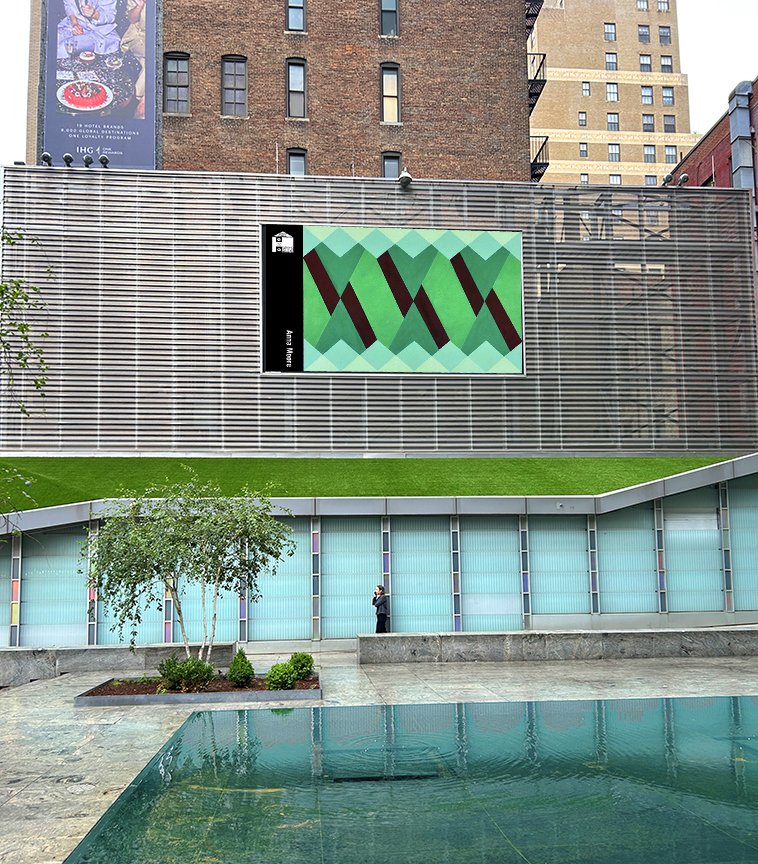
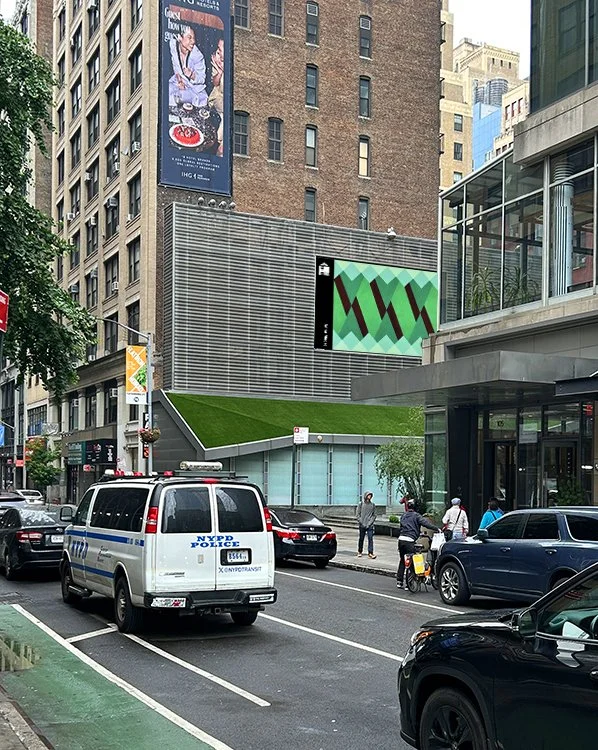
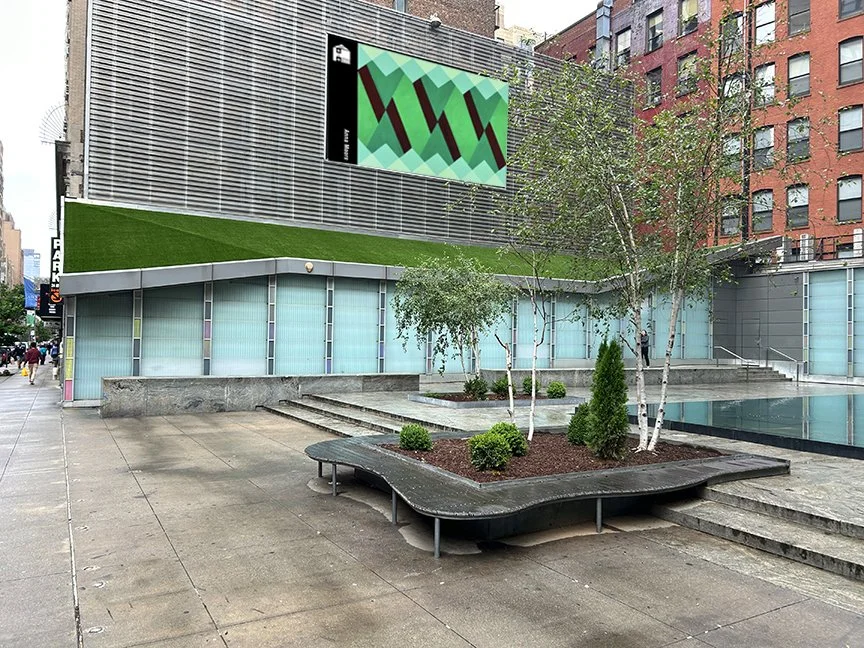
Big Screen Plaza
Chelsea, NY
April 2024
Interview/101 Artbook Photography Edition, 2026
Anna Moore On Making Gear Arrangements That Look Like Mandalas
At Arts to Hearts Project, our 101 Artbook series has been one of the most rewarding things we have ever built. Edition after edition, theme after theme, Floral, Animal, Nature, Abstract, Portrait, Landscape, Collage and more, we have watched this series grow into something we are genuinely proud of.
Every edition starts with one word and ends with a hundred and one artists showing us what that word means to them. And every single time the range of responses reminds us why we keep doing this.
For our Photography Edition we wanted to explore what photography means right now. Not just as a tool for capturing what is in front of you but as a full creative language with its own rules and its own ways of bending those rules. And the submissions that came in proved that photography in 2026 is so much broader and stranger and more personal than most people give it credit for.
Anna Moore is one of our selected artists in this edition. And her work challenged our idea of what a photograph even is.
Anna is based between New York and Chicago. She studied at the School of the Art Institute of Chicago and the University of Chicago. She has shown internationally in Florence, Venice, Paris, Los Angeles. Her work has been juried by MoMA curators. But none of that is what stopped us. What stopped us is what she is actually doing with photography and how far she is pushing it from what you would expect.
Her practice starts with questions. Real questions that she is genuinely trying to work through. Can mathematics engage the physical senses? What does trauma actually look like inside the body? Where does it live? These are not artist statement questions designed to sound interesting. These are the questions driving every decision she makes in the studio.
She works with photographic superimposition, layering transparencies of gears and anatomical models over X-rays and CT scans on a light box, photographing what appears, printing more transparencies, cutting them out, composing by hand.
The process is physical and layered and deliberate and the results are images that do not look like anything else we have seen. How exactly she builds these images and what she is looking for when the layers start talking to each other is something she explains in the interview and it is fascinating.
And then there is a whole other side of her practice that involves soft pastel and mathematical grids and French tarts. And yes those things are all connected. The way she connects them and why she thinks mathematics and baking and abstraction belong in the same conversation is one of the most unexpected creative frameworks we have come across.
She told us something about vulnerability and honesty in her practice that we think is really important. That her most recent work on trauma is probably her most honest because it comes from her own experience.
And that honesty and authenticity develop through practice and maturity and a willingness to explore the parts of yourself that are not pretty or comfortable or easy to show. We appreciated hearing that from an artist whose work has been validated by some of the biggest institutions in the world. Because validation does not make vulnerability easier. If anything it raises the stakes.
Let’s get to know Anna through our conversation with her about why her photographs start with questions instead of images, how gears and X-rays and light boxes become art, what French tarts have to do with mathematics, and why she believes your so-called mistakes might be the most important things you ever make.
Q1. Could you share a bit about your background and how your journey led you to develop your current abstract, process-driven practice?
My creative process starts with a question. For instance, the series Ode to a French Tart emerged from my love of both baking and mathematics, two disciplines governed by established rules. How are they similar? Different? Can rigidity be abstracted? Softened? And ultimately, can mathematics engage the physical senses?
In the series ‘Heartbreak of Trauma,’ I moved toward experiential forms of expression. What does PTSD or trauma feel like? “I feel it in my bones” is a common phrase—what does that look like? How does trauma affect the body, and where does it reside? My work is a visual metaphor for how trauma affects the body.
Specifically, misaligned gears slowly eating away at our vital organs represent how trauma impacts us. Trauma destabilizes individuals, fractures relationships, and increases vulnerability to further harm.
Q2. Soft pastel is such a fragile and luminous medium, what does it allow you to express that other mediums don’t?
I use soft pastel as a visual counterpoint to the grid’s rigidity. I hoped to show that math can touch our senses, not just our minds.
Q3. You work with root rectangles and mathematical grids before painting, what does that process look like for you in practice?
I use a ruler and compass to create a complex grid. The more complex, the better, giving me more to play with. I have always appreciated the clarity and precision of mathematics, which led me to incorporate grids into my artistic process. Although I often begin a piece by establishing its foundation with root rectangles, my work evolves beyond this structure.
Q4. Your Heartbreak series uses photographic superimposition, how are those images actually created?
I photograph my own gears and anatomical models, X-rays and CT scans, print transparencies, and layer these images over X-rays and CT scans on a light box to see what shapes appear. I then take more photos of the forms that speak to me, print more transparencies, cut them out, and create a composition. I try to do as much work by hand as possible because it leads to new ideas. Finally, I use Photoshop to soften edges and correct color.
Q5. Lime + Chocolate Tart is the first image visitors see on your website, why did that piece become the introduction to the series for you?
That’s a great question! It’s the most non-representational piece of the series. While it contains all the elements of the more literal representations of French tarts (triangular slices), the grid here is more complex. This complexity allows for more abstraction. It’s also the most dynamic, as the viewer’s eye first sees the chocolate before moving on to the different hues of lime green.
Q6. Your work has been shown internationally and recognized by major institutions, has that changed the way you see your work?
Validation, institutional or personal, definitely changes how I see my work. I would be lying if I said it did not! We all want and need validation.
Q7. Is there a particular period of your work that feels most true to who you are as an artist today?
For me, honesty and authenticity develop through practice and maturity, as well as a strong willingness to be vulnerable. The more work I create, and the more I explore the quirky, unconventional, and less attractive aspects of myself, the easier it becomes to express them. My latest work on trauma is likely the most honest, as it represents my own visceral experiences.
Q8. What advice would you give to artists who are learning to trust their intuition and develop their own visual language?
First, apply to every opportunity, whether an open call or a juried exhibition, since you never know who will see your work. Second, save your so-called ‘mistakes.’ Mistakes seen in a different context can lead to new directions.
As our conversation with Anna came to a close, we kept thinking about how fearless her work feels intellectually and emotionally at the same time.
A lot of artists begin with images. Anna begins with questions. Questions about mathematics, trauma, the body, memory, structure, fragility, repetition. Questions she genuinely seems compelled to work through visually until the work itself starts answering back in unexpected ways.
And honestly, that curiosity gives her practice so much life. We really loved hearing how physical and hands-on her process still is despite how conceptually layered the work becomes. The cutting, layering, photographing, rebuilding, working with transparencies by hand nothing about the work feels detached from the body making it.
That matters. Especially in a practice so deeply connected to themes like trauma and lived experience. Even when the imagery becomes abstract or heavily constructed, there’s still something deeply human underneath it all. You can feel someone trying to understand difficult things honestly rather than simply illustrating an idea.
There’s also something refreshing about the way Anna speaks about vulnerability. Not as a dramatic performance, but as something that slowly develops through time, maturity, experimentation, mistakes, and the willingness to explore uncomfortable parts of yourself without immediately trying to polish them away.
That honesty stays with the work. And maybe that’s why her images linger so strongly in your mind. They don’t behave like traditional photographs. They feel layered emotionally and physically, almost like fragments of thought, memory, science, and sensation colliding together into something entirely their own.
For people interested in contemporary photography and experimental image-making, Anna’s work opens up exciting questions about what photography can actually become when it moves beyond simple documentation and starts functioning more like a physical, emotional, and conceptual process.
That feeling of discovery runs through everything she creates.
https://artstoheartsproject.com/anna-moore-mandala-like-photography/